
The Good Life by Default
Choosing the cities that do the work, after the gayborhood
Draft v 4.2
I.
The air quality monitor on the windowsill read thirty-eight. Good. Better than most of the week, when it had sat in the fifties and once, on Wednesday, climbed past ninety while the light over the rooftops went the flat ochre Jordan had learned to read three summers earlier, the June the smoke came down out of Quebec and the city smelled like a campfire nobody had lit. He had bought the monitor that week, and the first purifier the same week, and a second one in the fall, so that three of them ran in the floor-through now without being asked, low white cylinders, and the one in the kitchen turned its ring of light from blue to amber whenever he seared anything, as if cooking were a kind of weather.
The coffee had gone cold while he stood there. It did that now. He set the mug down beside the pages he had printed on Thursday and been marking up since, a ranked list of a hundred and twenty-eight cities that someone with more patience than sense had scored on air, on climate, and on whether the kind of doctor who would not flinch at the two of them could be found inside the city limits. He had circled some and crossed out more, and the crossing-out had a momentum the circling did not, so that by Sunday the page looked less like a plan than like a subtraction.
His phone had been lighting up since before dawn with photographs from Beirut, where it was already afternoon. Karim’s mother sent them in no order and with no message, a slow stream of a cousin’s wedding on a hotel terrace above the corniche: twelve people in pale linen, a long table, a girl of eighteen in a green dress that matched nothing and plainly knew it. Karim had pointed her out the night before. She reminds me of me, he had said, and would not explain, and Jordan had not needed him to. He looked at her now, the cousin, half turned from the camera as though something past the edge of the frame were more worth her attention than her own wedding, and he sent back a heart and put the phone face down.
Down the hall the deep even breathing from Jordan meant another hour at least. They had bought the place four years earlier, the fourth-floor floor-through with the radiators that ticked, after nine years of renting two streets over, and Jordan had drawn the kitchen himself, the long oak counter, the window that held the morning. He still slept on the side of the bed he had slept on in the old apartment, against the wall, though there was no wall here and no reason. Karim’s screens were folded shut on the dining table that turned into an office at eight and back into a table at six, because the firm that paid him was in London and Karim was wherever the laptop was. Lately, he said this too often and not entirely as a joke.
By the door, on a hook between the bicycle key and the key to the studio, hung a third key on a loop of red boat line, to a clapboard house in midcoast Maine that belonged to a retired schoolteacher who lived in it ten months of the year, let them have it for the other two, and had not raised the rent in five summers. They had gone up every August for five years. The pharmacist at the grocery in town knew Karim by name. It was not theirs, and they did not want it to be theirs, exactly, and the wanting and not-wanting was a conversation they kept starting and not finishing.
On the shelf below, under a dish of loose change and dead transit cards, a manila envelope had been there long enough to take a ring from a coffee cup. Inside was a photocopy of his grandmother’s birth certificate, Cork, 1931, and the half-finished application for the Foreign Births Register that would make him, if he ever finished it, a citizen of a country he had visited twice. It had sat there two years. His grandmother had come over at seventeen and never gone back and would have found the whole project sentimental, and he knew this, and the envelope stayed where it was.
His phone, face down, still held the listing he had left open the night before: a two-bedroom in a town he had never lived in, three blocks from the water, a number where the price should be that he had looked at long enough to stop seeing. Below it, sent at some point after he had fallen asleep, was a line from Karim. so do we rent it for a winter and find out, with no question mark, the way Karim wrote questions when he already knew they would have to answer them eventually.
He did not pick up the pencil. Out on the parkway a bus sighed at the stop, the bodega’s shutter went up with its one long note, and the monitor ticked down to thirty-six.
II.
A monitor on a windowsill is a small confession. It admits that the air, which a city is supposed simply to have, has become something a household keeps, like a budget, or a dog, or a chronic condition.
For most of the history that produced Jordan’s neighborhood, the air was not kept. Nothing about the place was, in the sense he meant. The gayborhood, the dense and legible queer district the second half of the twentieth century built in a handful of American cities, did its work without being asked, the way the purifier had not yet had to. You went to it, in the old story, to get away from something, and what met you when you arrived was not only tolerance, and not only sex, and not only the bars. It was that the ordinary business of being alive had been arranged in your favor before you got there. The streets were walkable because the city was old. Your friends were close because the density made them close. The doctors who knew how to look at you had gathered where the patients were, and the food and the bookstores and the gyms and the parks and the rest of the people who had come for the same reasons were inside the same square mile, so that you could be healthy, and connected, and known, without ever quite deciding to be.
The numbers still describe that world. The Williams Institute at UCLA, working from federal survey data, puts roughly 706,000 LGBTQ+ adults in greater New York, the largest such gathering on the continent, with Los Angeles, Chicago, San Francisco, Miami, and a short list of others behind it.[1] Close to three million adults, give or take, in ten metros. The map of where queer people live in America is still, more or less, the map their grandparents drew by running toward each other.
That map was drawn for one set of shortages. Safety was short, information was short, tolerance was short, and so people crowded into the few places that had them. The shortages have eased since, unevenly and partway, but enough that the crowding is no longer the only way to live. While they eased, another set of shortages arrived that the map was never drawn for, and the first of them is the thing on Jordan’s windowsill reading thirty-six. The neighborhood that arranged a life in your favor cannot arrange the air. It cannot lower the temperature of the sidewalk in July, or call off the smoke that comes down in June from a forest a thousand miles northwest, or the water, or the storms, or the insurance that prices all of it. The purifier is what you buy when the old arrangement breaks, and the marked-up list on the counter is what you make when you begin to suspect that no amount of money will hold it in one place.
III.
Almost nobody is selling the quiet luxury that matters most, because it does not photograph and cannot be installed: living somewhere that makes a good life the easy thing to do.
By a good life, I do not mean comfort, and I do not mean the candlelit, spa-adjacent thing the word wellness now drags behind it. The phrase is soft, and the thing it names is not. The most useful hard version comes from the psychologist Martin Seligman, who set human flourishing on five legs: positive emotion, engagement, relationships, meaning, and the sense of getting somewhere.[2] Put physical vitality underneath as the floor they stand on, and you have a fair account of what people are really chasing when they chase a place. Not happiness, which is too thin a word, but the standing ability to feel good, to lose yourself in work worth losing yourself in, to be loved and known, to matter to someone, and to get better at something hard.
Almost none of it runs on willpower, though the optimization crowd keeps insisting it does. It runs on defaults. Thaler and Sunstein gave the idea its cleanest form: people do the easy thing, the thing the surroundings have already chosen for them, and to change what they do at scale you change the surroundings rather than lecture the chooser.[3] A place is choice architecture for a life. A walkable neighborhood does not make you disciplined; it spends your ten thousand steps for you on the way to dinner. A real food culture does not hand you willpower; it puts the good tomato within reach and the bad one out of the way. The old queer district did not make anyone connected; it made connection the thing that happened when you left the house.
This is why most of what gets sold as wellness misses the point. Bryan Johnson, who has spent a documented fortune trying to slow his own aging, is useful not for the supplements or the daily blood panels but for the dull core he keeps returning to: sleep, food, movement, company, and staying clear of what poisons you.[4] Nearly everything that matters is in the surroundings and close to free, and nearly none of it is for sale. The market sells what you can buy and plug in: the cold plunge, the supplement stack, the membership. It cannot sell you air you do not have to filter, or a street you can walk after dark, or a Tuesday with a friend in it that nobody had to schedule, or a climate that lets you outdoors in February and August both. The version it has learned to sell is called wellness-rich urbanism, and it is the soft cover of a hard book.
The hard book reads like this. As people become better off and the basics are handled, the next thing they buy is not more but less: less friction, fewer of the small daily costs the body and the calendar pay without anyone noticing. Clean air is turning into a status good, not because anyone brags about it, but because we now read bad air, heat, noise, and low-grade dread as a tax the body pays slowly, over decades.[5] The place worth paying for is the one where the easy thing is also the good thing, and there is still somewhere to go on a Friday evening.
For queer people, the specification runs longer, because the place has to supply two things the general version can skip: enough of a community that you do not have to hunt for it, and a government that will not write your body or your marriage out of the law. Add those to clean air, walkable streets, decent food, and cultural interests, and you have the whole list. The old district met all of it at once, inside a square mile, for nothing. What Jordan had been crossing his way toward on the counter was whether any one place still could.
IV.
The list on the counter was the answer, and the answer was no.
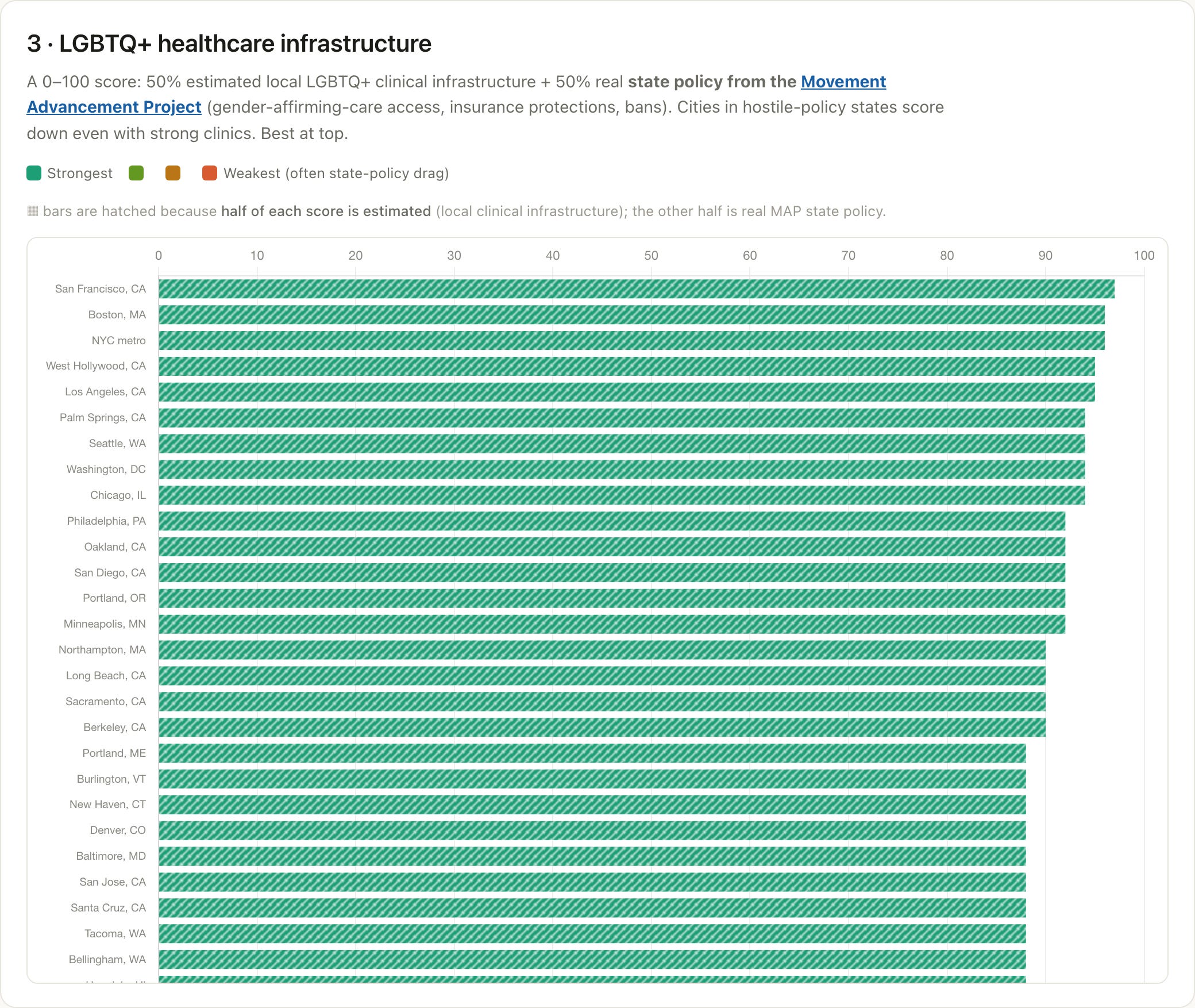
Someone had built it as a model and said so at the top, in the apologetic voice of a person who knows the numbers are estimates: a hundred and twenty-eight American cities and queer-friendly towns, each scored on three things that almost never sit in the same table.[6] Projected air in the 2050s, smoke folded in. A composite of climate resilience, from coast and sea level through water, heat and fire, storms, and the capacity to adapt. And a homemade score for queer-competent care that leaned hard on state law, on the logic that a brilliant clinic in a state that has outlawed the treatment is not care. The inputs were real, drawn from the Stanford lab that maps daily wildfire smoke, the American Lung Association’s air rankings, the federal risk index, the sea-level projections, and the policy trackers.[7] The model was a toy. The pattern under it was not.
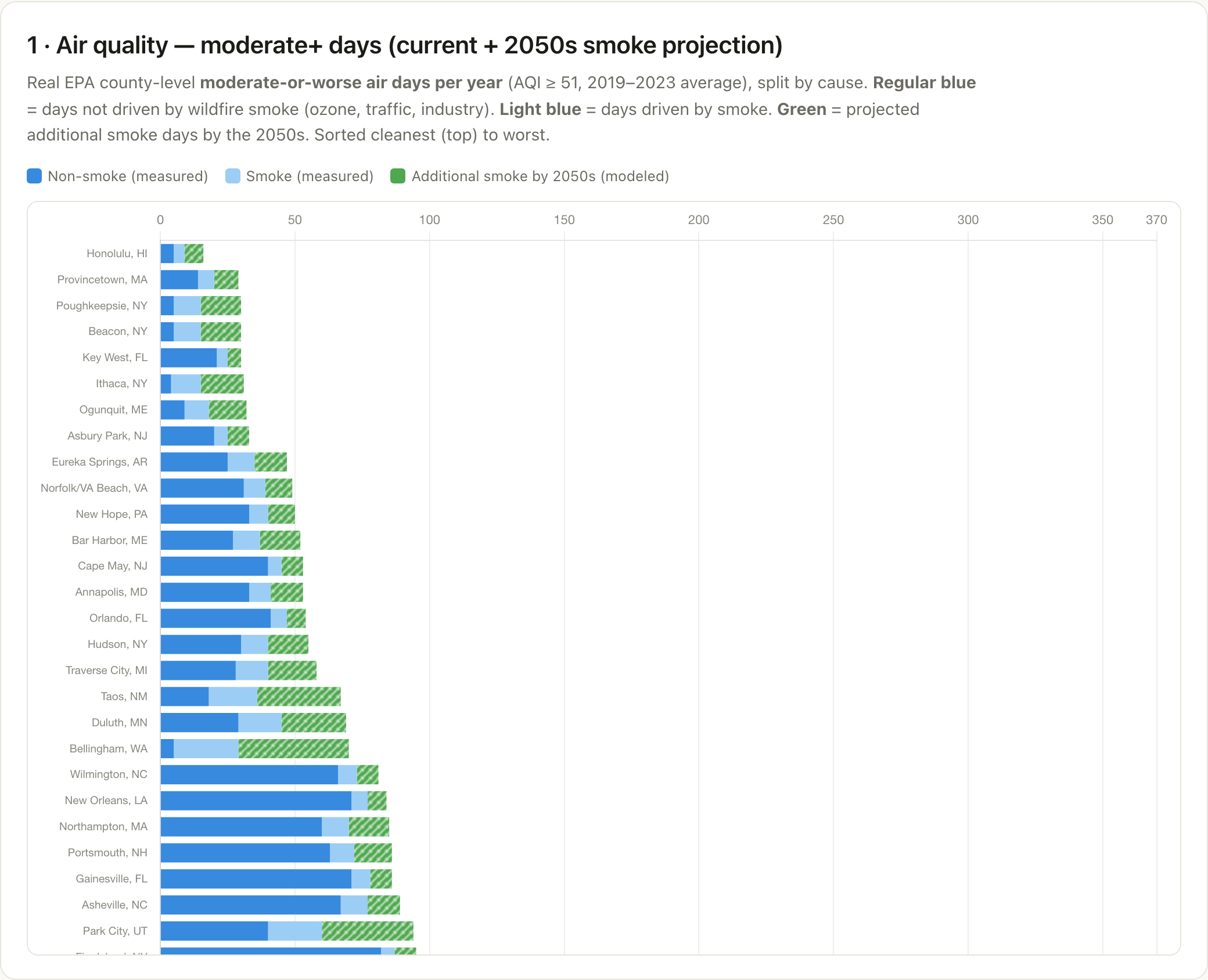
The pattern was that the three maps refused to lie on top of one another. Where queer people had built their famous places, the climate map went dark. Provincetown sits out on a hook of sand; Fire Island is a sandbar with a boardwalk; Key West is barely above the sea that is rising under all three, and the model put them near the bottom of the hundred and twenty-eight for resilience, down there with the gay strip of Fort Lauderdale around Wilton Manors.[8] Out west, the trouble was smoke. Denver, the West Hollywood end of Los Angeles, Palm Springs, sitting in the desert running low on water: the fire seasons reach all of them now, and stretch a little longer each decade.[9] The Sun Belt cities the young queer crowd moves to for cheap rent and sun, Austin, Houston, Atlanta, and Nashville, lost points twice, once to heat and storms and once to the statehouses around them.[10] Even the great old metros came back middling. New York, Boston, and Chicago score high for care and ordinary for resilience, and Chicago, which nobody used to call a hot city, now cooks through Augusts that the heat wave of 1995, the one that killed 739 people, was supposed to have warned it about.[11]
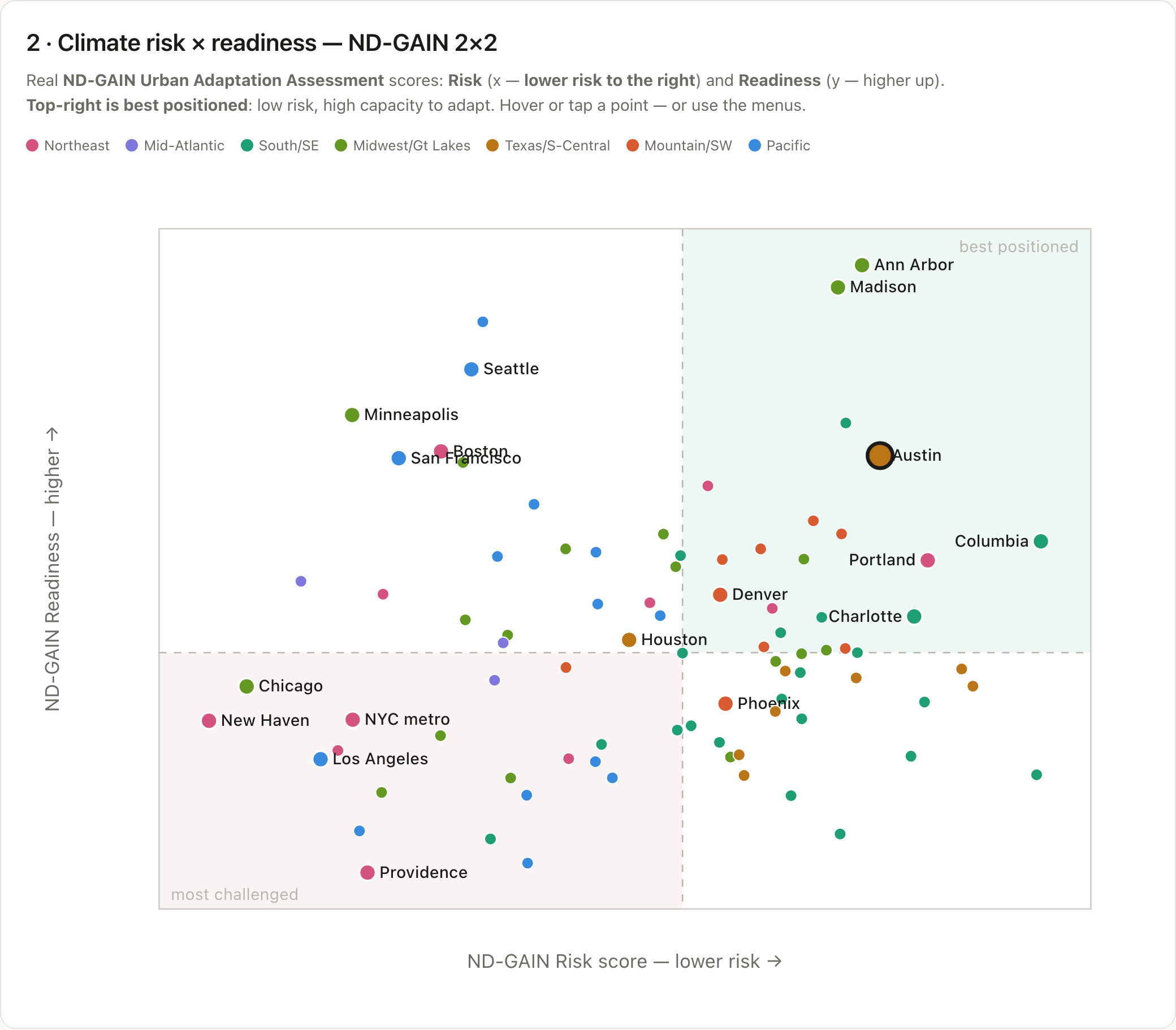
The places that scored well were the ones almost no one had ever moved to in order to be gay. The top of the resilience list was a band of northern towns and small cities: Ithaca, Northampton, Ann Arbor, Portland up in Maine, and Hudson on the river.[12] Clean air, water that is not running out, summers a person can still stand, and in several of them a university, a hospital, and a blue county to keep the medicine and the law humane. They are real places, and some of them are beautiful. They are also, every one, places where queer life is a thin scatter rather than a scene, and where winter is a fact five months long that the charts don’t mention.
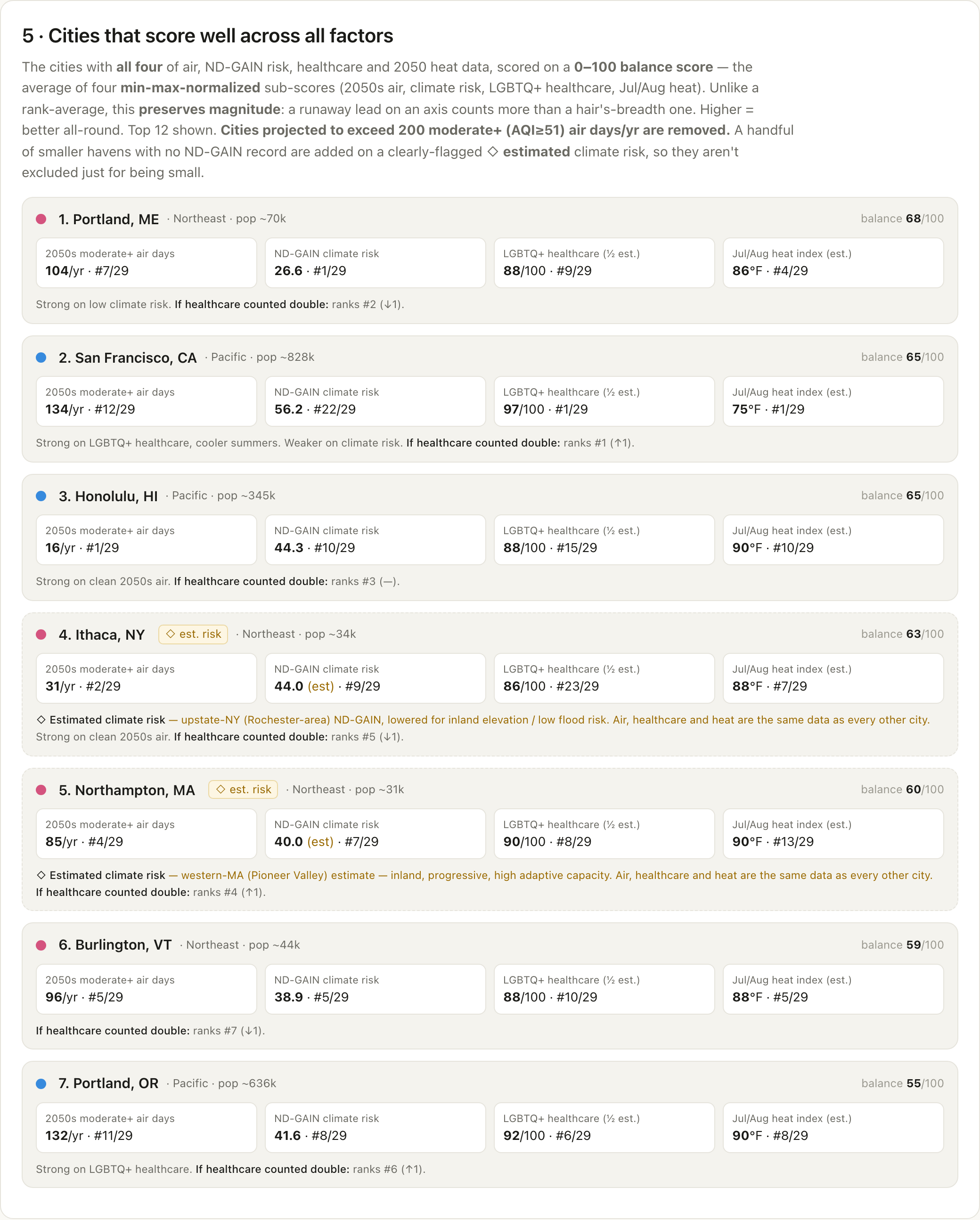
Burlington is the tell. It sits high on the resilience list, and people reach for it as the obvious safe harbor, and the same model that ranks it well hands it the heaviest smoke forecast in the Northeast, more bad-air days by the 2050s than New York or Boston, because it sits closer than they do to the Canadian forests that are going to keep burning.[13] The haven comes with an asterisk. Most of them do.
And then there was everything the list could not see, which was most of a life. The model scored air and climate and clinics, the things that take a number. It had no column for whether you would have a friend within walking distance, or a bar worth walking to, or work that took you out of yourself, or any reason to believe your being there mattered to one other person. It could rank the air in Ithaca. It could not tell you whether you would be lonely there, and loneliness is not a soft thing; it shortens lives. Four of Seligman’s five legs, the engagement and the relationships and the meaning and most of the good feeling, stand exactly in the blind spot of every index like this one. The cleanest dot on the whole chart was a town where the air was perfect and Jordan knew no one. The list could tell him where to breathe. It could not tell him where to live.
V.
The list could not tell him where to live, so he tried to do it himself, the way you test a coat by walking it across the store. He took the floor-through and the parkway and the walk to the market he could do with his eyes shut, and he ran them forward into the 2040s, and the 2050s, and as far as the 2060s, to see what would still be standing.
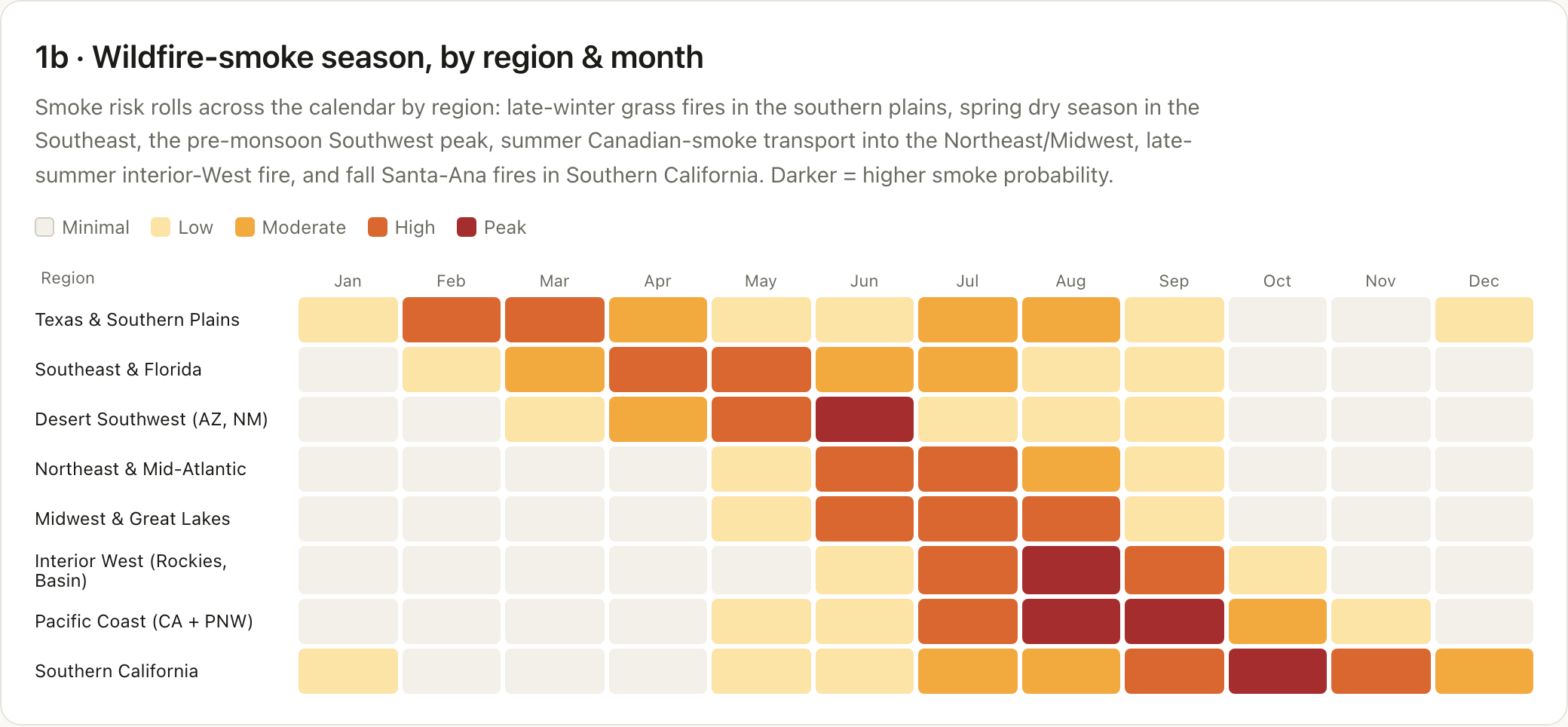
The 2040s arrived as subtraction, which was the form he had been reading on the page all morning. Not catastrophe. The summer only got longer at both ends and meaner in the middle, until the stretch of the year a person could be loosely, thoughtlessly outside, the stretch the whole good life quietly ran on, narrowed to something you checked a forecast before trusting.[14] The monitor on the sill stopped being a curiosity and became the thing he read before deciding whether the morning was his to use. Smoke that had once been a freak week in June came for three weeks, then five, the sky the color of weak tea, the kids kept in at recess, the market under the parkway pushed back to seven in the morning and then, some Augusts, called off.[15] People still went out. They went the way you go out into deep cold, on purpose and for a reason and not for long, and the walking that used to spend his ten thousand steps for him became a thing he had to mean to do, indoors, on a belt, paying a membership for what the street had given him for free.
Past that, he could mostly picture the decade through what it would cost, which was the part that caught him: not the heat so much as the invoice for it. The first letter from the carrier, the one saying it would no longer write policies in the region. A friend out in the Rockaways had gotten hers in the twenties, and then the whole block had, until the only thing left to buy was the state’s plan of last resort, at the price of a second mortgage.[16] Inland was supposed to be the safe word, and inland went under too, because the rain had quit falling in reasonable amounts over reasonable hours and started arriving a season at a time in one night. Montpelier drowned in 2023 and again the next July, and Montpelier was exactly the kind of cool green high-ground town the list ranked near the top.[17] This was the climate showing up at last as a figure he could read, every degree priced and charged back to the household, the cost of staying somewhere turned from a thing carried in the body to a line on a statement he could not always pay. The slack a good life runs on, the plain room to be unworried about money, was the first thing the bill came for.
The far end, the 2060s, he could not see clearly, partly because he would be pushing eighty by then, and the picture ran into his own old age and stalled. The shape of it was plain enough. The towns that had spent the decades laying down shade and banking their water and hardening their grids would be expensive and crowded and held tight by the people who reached them early; the towns that had not would be cheaper and emptier and hot. And the body that does the walking and the swimming and the long idle standing-around-talking a good life is actually built from would be older by then, slower to shed heat, more reliant than it had ever been on a place willing to do the work it no longer could. That was the turn that unsettled him most, sitting there with his cold coffee. The years he would need the easy version most, when effort could no longer make up for whatever the place stopped giving for free, were the same years the climate would be busiest taking the easy version away.
VI.
The error is to keep looking for the one dot that has everything, when the list has just shown there is no such dot. The old question assumes a single answer: where should I move, one place to be home and carry the whole specification at once. That place was the gayborhood, and the gayborhood is the very thing the three maps are tearing apart.
It helps to separate what a place gives you into what you can take with you and what you cannot. Some of it is portable. It travels in the body and the habits and the paperwork: your sleep, your training, your food, your screenings, your records, your second passport, the discipline you can run anywhere. The rest is place-bound, and place-bound things do not transplant. A walkable street, clean air, a survivable summer, the friend three blocks away, the doctor who has watched you for twenty years, a scene that took forty years to grow: pull them up by the roots to carry them somewhere, and most of what mattered stays in the ground.
The portable things you can perfect alone, and the kind of person likely to read this mostly has. The place-bound things are the whole game, and the new discovery is that they no longer come together in one spot. The old district came as a single living thing, air and sidewalks and company and medicine and culture grown into one organism, and climate and politics are pulling that organism apart and scattering the pieces across different cities.
So instead of buying one place, you assemble a few, each carrying the part it is actually good at. Not a primary home and a vacation house, which is the old rich arrangement and means something else, but a real division of a life across two or three places that each do one thing well. One holds the center: the community, the work, the long roots, and for most people, that stays a version of the city they are already in, because that is where the people are. One takes the months the center cannot, the smoke weeks or the killing August or the dead-cold February, somewhere built for the opposite weather. One, maybe never lived in, is the way out: a country you have the right to enter and stay in if the politics where you live ever cross a line, which for Jordan is the envelope by the door and the grandmother from Cork. And maybe one for the shortened winter months white retired, like the traditional snowbird approach.
The seasonal piece nearly falls out of the map on its own. The northern towns that score well are unlivable a third of the year and glorious the rest; the warm places are the reverse, and tilting further that way each year. A life that summered in Maine and wintered where the cold never reaches is not, seen this way, an indulgence. It is a way to stay outdoors and walking and in front of other faces all twelve months instead of hiding from the weather for five of them. The snowbirds had the structure right and the reasons wrong.
None of it works at the size of a metro, which the list got wrong because it had no choice. You do not live in a region. You live on a street. A good life is built inside the quarter mile around the bed you sleep in: the coffee, the park, the gym, the friend, the market, the doctor, the corner where you keep running into people you did not plan to see. A city can score beautifully and still hand you your life through a windshield, on trips between errands. When Jordan circled a town, the real question under the circle was never the city. It was whether one walkable quarter-mile of it would ever do for him what Crown Heights already did.
VII.
Karim’s text had not had a question mark. so do we rent it for a winter and find out. Renting was the whole point. The temptation, once you can afford it, is to buy the second place, to own the haven outright, but buying is a bet that you have already chosen right, and the list on the counter was proof that Jordan had chosen nothing yet. You rent what you are still testing and you own, if you own anything, the one place you are sure of, the one with the people in it. Renting keeps the only thing the whole arrangement exists to protect, which is the freedom to be wrong: wrong about Maine, wrong about the town by the water, and able to walk away from a lease instead of a house.
This is also where the money turns and argues against itself. Two or three places cost more than one, in rent and flights, and the overhead of a life run in duplicate, and the slack that a good life quietly leans on, the margin that keeps cost from eating your time and attention, is exactly what the second lease eats first.[18] The arrangement works cleanly only for a household with real room in its budget. Jordan’s had it. Most do not, and the arrangement is not for everyone, whatever the listings imply.
The dearer cost is not money. It is what spreading out does to the people. A friendship survives a move; being present does not survive being in two places. The thing the old district did best, the friend who turned up on a Tuesday that no one had to arrange, is exactly the thing that does not survive three time zones. Jordan’s closest people were already scattered, one in Berlin, one in Denver, two of the old Saturday crowd dead, the table that once sat eight on a weeknight now something that took a group thread and a month’s notice to fill. The friend in Berlin was still the friend in Berlin; distance had not touched that. But no one in Berlin could come when the night went bad. A life spread wide gives you many places and can leave you fully present in none, and the relationships and the mattering that wellbeing sets at the center grow out of presence, out of the unplanned and the repeated, not out of visits.
Jordan had a picture of where the spread-out life ended if you ran it long enough, and the picture was Russ and Tomás. Together since 1982, which in their crowd was a small miracle of arithmetic, they had run for thirty years the arrangement Jordan was now turning over: a rent-stabilized apartment on the Upper West Side for spring and fall, a low pink house in Palm Springs for the winters, summers wherever a friend would take them in. Russ still did the crossword in pen and still finished it. For three decades it had been the good life as advertised: warmth when New York went grim, the city when the desert turned to an oven, two sets of regulars, a marriage that had outlived most of the people who said it could not be done.
It held until Russ was eighty-four and had the stroke, in March, in Palm Springs. After that, the arrangement that had been freedom turned into a trap with two jaws. The neurologist who knew the case was in California and the cardiologist was in New York, and neither could read the other’s notes without a release that took weeks, and Tomás, seventy-nine and not strong himself, became the courier, carrying a black accordion folder coast to coast because the systems would not speak to one another, the folder with the medication list and the scans and the advance directive and the power of attorney that named Tomás and no one else, because there was no one else. They had two homes and could not safely be in either, since each one held half the care. The long beautiful drive across the desert in October was the first thing the doctors took. Then the flights got hard. Then they stopped. By the next winter the pink house was for sale and they were down to one place, a place neither of them had chosen for being old in, because the two-home life a body runs easily at sixty-five it cannot run at eighty-five, and almost no one plans for the gap between.
That is the part the brochure leaves out as surely as it leaves out the Vermont winter. The seasonal place and the way out and the rest are tools for the decades when you are well and able to move, your fifties and sixties and, with luck, your seventies. The tools do not serve the years after, when moving itself becomes the danger and the whole spread-out system has to fold back to a single point, chosen for a short walk to a doctor and the people who will actually come. That last place is the one you are meant to pick first and use last, and Russ and Tomás ran a brilliant version of everything else for thirty years and never picked it, so it picked them, in an emergency, badly.
Jordan thought about the folder whenever he looked at the key on the red boat line. The Maine house was a habit they had stopped being able to call only a habit. The town by the water was a question turning into a decision. Past both of them was a place he had not let himself look for yet, the one with the short walk to the doctor, and he was forty-one, and it was too early to choose it, and that, the folder told him, was exactly why now was the time to start.
VIII.
The strongest case against everything Jordan had been thinking did not come from a skeptic. It came from Russ and Tomás, and from the table that now took a month’s notice to fill.
Here is what the spread-out life cannot answer. A flourishing life is not a set of amenities you assemble; it grows, slowly, out of staying. The relationships and the meaning at the center wellbeing are made of tenure, of being the one who has sat at the same table for fifteen years, who is owed favors and owes them, who is known. You cannot rent that by the season. A collection of places, each tuned to a single variable, can produce a life that scores well on every axis and is starved on the one that compounds: present everywhere, rooted nowhere. The clean air in the haven does not love you back. Russ and Tomás were not undone by climate, or by any law. They were undone by spreading a life so wide that when it finally folded, there was just one other person still standing inside it.
The objection is mostly right, and it is why this is not the argument it first appears to be. If the lesson were go everywhere, it would be wrong. Belonging grows where it is planted and slowly, and a life cut into pieces never puts down enough of it anywhere. A rooted life in a flawed city beats an optimized life in fragments.
But the argument does not say go everywhere. It says plant first, then hedge. The whole thing rests on one place holding the relationships and the tenure and the table, kept for decades, defended against the temptation to trade it for a better climate score. The other places are not rival homes. They are insurance, and relief, and a soft landing, arranged around the rooted one so the rooted one can be kept. The spread is what lets a person stay put somewhere real while the climate makes that real place unlivable for stretches, instead of being driven into the single brutal late-life move that the research counts as a hazard of its own.[19] Done with care, it guards belonging more than it threatens it.
Karim had said it aloud already, more than once, usually with the listing open in front of him. who is this for, he had said. we can do this. most of the people we love cannot. He was right, and it is the objection to give in to without a fight. The whole apparatus, the second lease, the flights, the passport, the cushion to be wrong about a town, belongs to one narrow and lucky band: portable income, no dependents holding them in place, savings, a trade that crosses borders. Naming that band is not a defense of it. It is the only reasonable way to hand the argument to the people it actually fits.
And the household that will only ever have one place is not left with nothing. The same map that argues for a spread argues, for everyone else, for choosing the one place far more carefully than the generation before ever had to: scoring the single city you can manage on air and heat and water and walkable streets and the law, finding the good quarter mile inside it, and counting the place’s own survival as part of your health, because it is. The spread is the luxury version. The thing underneath it, choosing your defaults on purpose instead of inheriting them, costs nothing.
One piece of this is a forecast, not a finding: that the gayborhood is giving way to a network at all. The hard count still shows queer people gathered in the same ten metros their grandparents chose, not dispersing into a lattice of seasonal addresses.[20] Maybe the district holds and adapts, behind sea walls and filters and air conditioning, and the spread stays a rich household’s hobby. The four-place life is a bet on which way the wind blows. The discipline underneath it holds either way.
IX.
Karim came down the hall a little after nine, barefoot, hair flat on one side, and stood behind Jordan reading the page over his shoulder the way he read everything, fast and then again slowly. The monitor said thirty-one. The morning had warmed and the light had gone plain and good.
Sometime in the last hour the page had stopped being a list of a hundred and twenty-eight places and become a much shorter thing. Most of it was crossed out. What was left was not a plan, exactly, but it was no longer only a subtraction. Crown Heights at the top, uncrossed, never in question, the place with the people in it. Maine, circled, the habit they would stop pretending was only a habit. The town by the water, with a question mark Jordan had finally let himself write as a question mark. And down in the margin, smaller than the rest, he had written Cork, and a date, the date the envelope by the door had been waiting two years for him to set.
So do we rent it for a winter and find out, Jordan said, handing Karim back his own line, and Karim said yes the way you answer a question you asked first. They would rent, not buy. One winter in the town by the water, a trial and not a vow, a lease a person could walk away from. The Maine deposit was already down for August. The envelope would go out Monday, the application finished at last, the fee that he now remembered was two hundred and seventy-eight euros.[21]
The last place, the one with the short walk to the doctor, he did not write down. It was too early, and Russ and Tomás had taught him that too early was the only time anyone got to choose it. He left a blank line for it under the others.
Karim made the coffee Jordan had let go cold, and the kitchen purifier turned its ring from blue to amber as the kettle came on, reading the steam as weather, the way it read everything. On the counter the phone had gone dark over the photograph from Beirut, the cousin in the green dress still looking off at whatever it was past the edge of the frame. Jordan folded the page along the crease already forming in it and hung it by the door, behind the key on the red boat line, where he would see it leaving and see it coming home. Then he stood at the window with Karim while the street filled up, and they drank the coffee, and the monitor read thirty, and the light came down through the plane trees on the parkway the way it did on the mornings that still came for free.
Explore the data
The ranked list in this essay is real. You can open it and find your own city: Queer Horizon — LGBTQ+ Cities × Climate, Air & Healthcare.
Air quality, current + 2050s smoke projection (figure: air.png)
Air quality by month (figure: airmonth.png — optional)
Wildfire-smoke season by region & month (figure: smokeseason.png)
Climate risk × readiness — ND-GAIN 2×2 (figure: ndgain.png)
LGBTQ+ healthcare infrastructure (figure: healthcare.png)
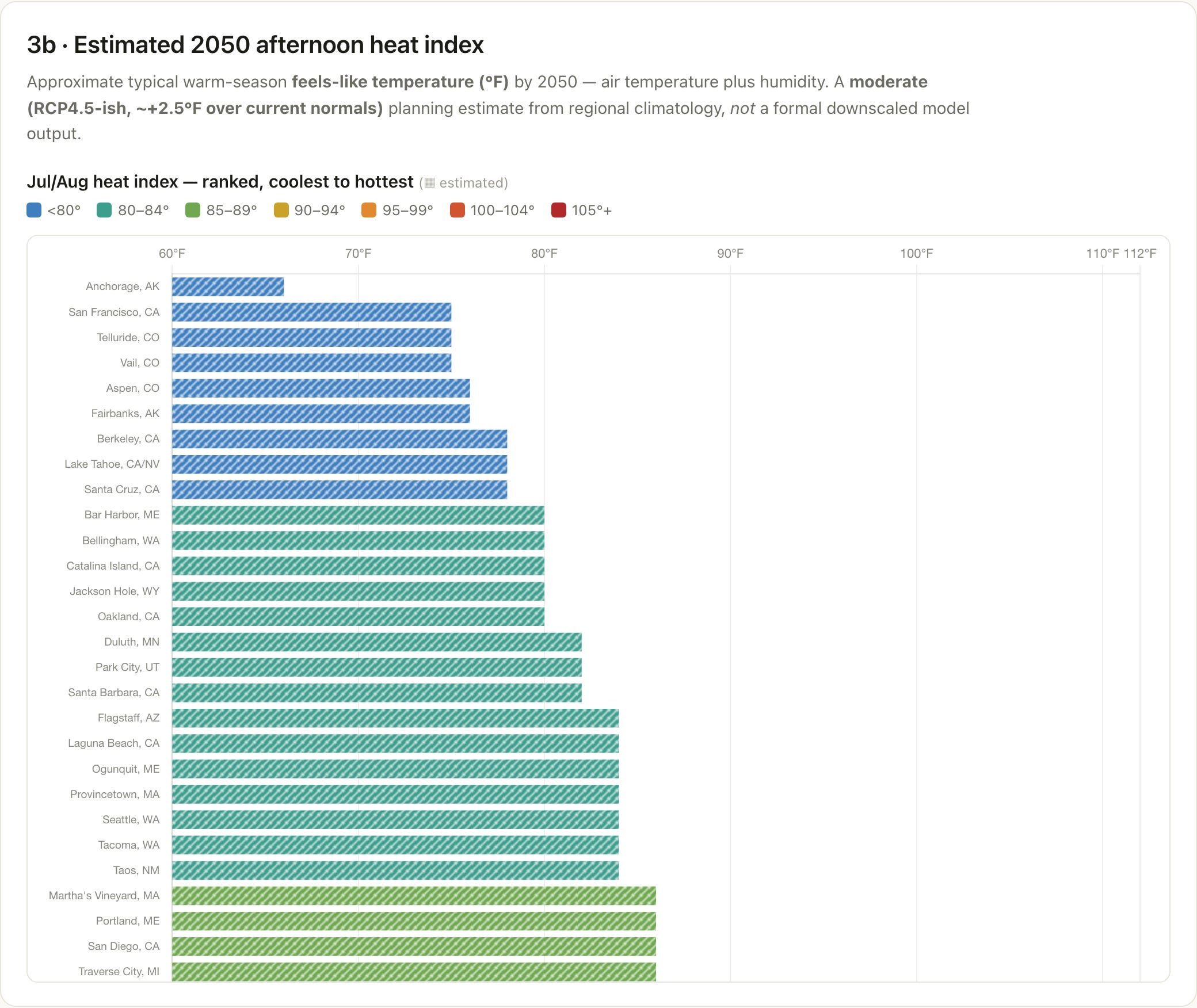
Estimated 2050 afternoon heat index (figure: heat.png)
2050s air quality × climate risk (figure: cross.png — optional, good near the Burlington passage)
Cities that score well across all factors (figure: shortlist.png)
Notes
Citations resolved 2026-06-22. Sources cross-referenced against the project research files; claims new to this draft were independently researched and verified. Bracketed flags mark currency caveats, model-versus-finding distinctions, and one factual correction needed in the body (note 17).
1. Williams Institute, UCLA School of Law. LGBT Adults in Large US Metropolitan Areas. March 2021. https://williamsinstitute.law.ucla.edu/publications/lgbt-us-msa/. New York–Newark–Jersey City ≈ 706,000 LGBT adults; the aggregate of the top ten metros is ≈ 2.99 million. [Gallup-based estimate; the most recent metro-level breakdown available — verify currency before publication.]
2. Seligman, Martin E. P. Flourish: A Visionary New Understanding of Happiness and Well-being. New York: Free Press, 2011. The PERMA model: positive emotion, engagement, relationships, meaning, achievement.
3. Thaler, Richard H., and Cass R. Sunstein. Nudge: Improving Decisions About Health, Wealth, and Happiness. New Haven: Yale University Press, 2008; revised “Final Edition,” New York: Penguin, 2021. Choice architecture and the power of defaults.
4. Johnson, Bryan. “Blueprint Protocol.” https://protocol.bryanjohnson.com/. The five pillars are sleep, nutrition, exercise, mental health, and supplementation; the regimen is widely reported at roughly $2 million per year. The essay draws only on the accessible core, not the proprietary stack.
5. Air pollution: Shi, Longxiang, et al. “Incident Dementia and Long-Term Exposure to Constituents of Fine Particle Air Pollution.” PNAS 120, no. 1 (2023): e2211282119; Shi et al., Nature Communications 12 (2021): 6754; Lelieveld, Jos, et al., European Heart Journal 40, no. 20 (2019): 1590–1596; Landrigan, Philip J., et al. “The Lancet Commission on Pollution and Health.” The Lancet 391 (2018): 462–512. Heat: Kovats, R. Sari, and Shakoor Hajat. “Heat Stress and Public Health: A Critical Review.” Annual Review of Public Health 29 (2008): 41–55. Noise: WHO Regional Office for Europe and the European Commission JRC, Burden of Disease from Environmental Noise: Quantification of Healthy Life Years Lost in Europe (2011); updated in European Environment Agency, Health Risks Caused by Environmental Noise in Europe (2020). [Lead with EEA 2020 for current burden figures; WHO 2011 is the foundational estimate.]
6. The index is the author’s exploratory heuristic composite, not measured data. Every city-level figure attributed to it is a model estimate, and its comparative rankings (see notes 8, 12, 13) are the model’s output rather than published projections.
7. Data sources named by the index. Wildfire smoke: Childs, Marissa C., et al. “Daily Local-Level Estimates of Ambient Wildfire Smoke PM2.5 for the Contiguous US.” Environmental Science & Technology 56, no. 19 (2022): 13607–13621 (Stanford ECHO Lab; data at https://www.stanfordecholab.com). Air quality: American Lung Association, State of the Air (annual), https://www.lung.org/research/sota. Natural-hazard risk: FEMA, National Risk Index for Natural Hazards, https://hazards.fema.gov/nri. Parcel-level risk: First Street Foundation, https://firststreet.org. Sea level: Sweet, William V., et al. Global and Regional Sea Level Rise Scenarios for the United States. NOAA Technical Report NOS CO-OPS 083 (2022); NOAA Sea Level Rise Viewer, https://coast.noaa.gov/slr. Care competency and law: HRC Healthcare Equality Index, https://www.hrc.org/resources/healthcare-equality-index; Movement Advancement Project, Equality Maps, https://www.mapresearch.org/equality-maps.
8. Resilience scores for Provincetown, Fire Island, Key West, and Wilton Manors are index model output (note 6); their sea-level exposure derives from the NOAA sea-level scenarios and viewer (note 7).
9. California wildfire-smoke estimates: Stanford ECHO Lab (note 7) and Jaffe et al. 2023 (note 15). Water stress: U.S. Bureau of Reclamation Colorado River shortage determinations (Lake Mead tier declarations, 2021–present); Congressional Research Service, Management of the Colorado River: Water Allocations, Drought, and the Federal Role, R45546. Coachella Valley groundwater overdraft: Coachella Valley Water District; California Department of Water Resources SGMA basin prioritization. Palm Springs municipal water is drawn from the local groundwater basin, which is in overdraft.
10. Movement Advancement Project. Equality Maps: Snapshot of LGBTQ Equality by State. https://www.mapresearch.org/equality-maps. Tallies of state-level LGBTQ+ policy.
11. CDC. “Heat-Related Mortality — Chicago, July 1995.” MMWR 44, no. 31 (1995): 577–579. Whitman, Steven, et al. “Mortality in Chicago Attributed to the July 1995 Heat Wave.” American Journal of Public Health 87, no. 9 (1997): 1515–1518. Klinenberg, Eric. Heat Wave: A Social Autopsy of Disaster in Chicago. Chicago: University of Chicago Press, 2002. The figure of 739 is the excess-death estimate.
12. Resilience and air rankings for Ithaca, Northampton, Madison, Duluth, Ann Arbor, Portland (ME), and Hudson (NY) are index model output (note 6). Air quality is independently checkable through American Lung Association State of the Air and EPA AQS historical data.
13. The Burlington-versus-New York/Boston smoke comparison is index model output (note 6). The underlying mechanism — intensifying boreal fire reaching the Northeast — is supported by Kirchmeier-Young, M. C., et al. “Human-Driven Climate Change Increased the Likelihood of the 2023 Record Area Burned in Canada.” npj Climate and Atmospheric Science 7 (2024): 316; and Jaffe et al. 2023 (note 15).
14. Projected rise in cooling-degree-days and dangerous-heat days, and the shrinking window of comfortable outdoor days: Fifth National Climate Assessment (2023), https://nca2023.globalchange.gov; Climate Central, High Heat Index Days analysis; IPCC, Sixth Assessment Report (2021–2022).
15. Jaffe et al. “Projected Increases in Wildfires May Challenge Regulatory Curtailment of PM2.5 over the Eastern US by 2050.” Atmospheric Chemistry and Physics 23 (2023): 1769–1783. Chen, Han, Weihang Zhang, and Lifang Sheng. “Canadian Record-Breaking Wildfires in 2023 and Their Impact on US Air Quality.” Atmospheric Environment 342 (2025): 120941. The 2023 Canadian season burned roughly 15 million hectares and drove record multi-week smoke episodes into the eastern US.
16. California FAIR Plan, Key Statistics & Data (policies in force up ~139% since September 2021; ~$4 billion in losses from the January 2025 Los Angeles fires; 36% rate-increase request), https://www.cfpnet.com/key-statistics-data/; California Department of Insurance residential non-renewal data; First Street Foundation, The 9th National Risk Assessment: The Insurance Issue (2024). The Rockaways scene corresponds to the New York Property Insurance Underwriting Association (NYPIUA), New York’s FAIR plan of last resort.
17. Clausius–Clapeyron scaling (~7% more atmospheric moisture per °C of warming) and the intensification of extreme precipitation: IPCC, Sixth Assessment Report, Working Group I (2021), chs. 8 and 11. Vermont flooding: USGS, Flood of July 2023 in Vermont, Scientific Investigations Report 2025-5016 (Montpelier downtown and the Winooski River inundation confirmed). [CORRECTION NEEDED IN TEXT: Montpelier was largely spared in July 2024 — the Winooski crested roughly six inches below flood stage; the July 10–11, 2024 flooding struck Barre, Plainfield, Moretown, and Marshfield, not Montpelier itself. Revise “Montpelier drowned in 2023 and again the next July” accordingly — e.g., name central Vermont for the 2024 event, or keep Montpelier for 2023 alone.]
18. Housing-cost-burden thresholds (housing costs above 30% of income; severe burden above 50%): U.S. Department of Housing and Urban Development, Worst Case Housing Needs reports. Effect of cost pressure on discretionary time and attention: Mullainathan, Sendhil, and Eldar Shafir. Scarcity: Why Having Too Little Means So Much. New York: Times Books, 2013.
19. Relocation Stress Syndrome (”transfer trauma”) and the health risks of involuntary late-life moves: Castle, Nicholas G. “Relocation of the Elderly.” Medical Care Research and Review 58, no. 3 (2001): 291–333. [Claim type: established for institutional/involuntary transfers; the essay’s consolidation-from-two-homes-to-one is an inferential extension of this literature, which is drawn chiefly from nursing-home transfer studies. Carry the mechanism, not the specific mortality figures.]
20. Williams Institute, UCLA School of Law (see note 1). Current metro-concentration data for LGBTQ+ adults.
21. Department of Foreign Affairs, Ireland. Registering a Foreign Birth (Foreign Births Register). https://www.ireland.ie/en/dfa/citizenship/born-abroad/registering-a-foreign-birth/. Adult application fee €278 (child €153). [Confirmed.]